
The $8.5 Trillion Question: Why Smart Leaders Are Betting on Reskilling
When Satya Nadella took over Microsoft in 2014, he inherited a company many saw as a fading giant. But he didn’t just pivot the product strategy—he transformed how the company thought about its people. His mandate was simple but radical: shift from a culture of “know-it-alls” to “learn-it-alls.” Within five years, Microsoft’s market value tripled.
This wasn’t magic. It was reskilling as strategy.
The AI-Accelerated Cliff Edge
By 2030, the World Economic Forum estimates that over one billion people will need reskilling. That’s not a skills gap—it’s a skills chasm. And artificial intelligence is accelerating the timeline dramatically. The skills essential six months ago may be automated tomorrow.
Yet most leadership teams still treat training as a cost center, something to cut when budgets tighten.
A mid-sized manufacturing firm in Ohio faced this exact tension. When automation arrived, management could either lay off experienced welders at a replacement cost of $15,000 per person or reskill them for $4,000 each. They chose reskilling. Within eighteen months, former welders were programming robots and training others. The company became the regional leader in advanced manufacturing.
The CFO later admitted, “I was looking at training as an expense. I should have been looking at talent loss as the real cost.”
The AI Inflection Point
Here’s what makes this moment different: AI isn’t just automating manual tasks—it’s augmenting cognitive work we assumed would always require human expertise.
A major accounting firm discovered that entry-level analysis that once took weeks could now be done by AI in hours. Their response wasn’t mass layoffs—it was massive reskilling. Junior accountants learned to work alongside AI tools, focusing on interpretation, client communication, and strategic judgment.
Within a year, productivity per employee increased 40%. More importantly, they retained people who understood their clients deeply while making them exponentially more capable.
The insight: AI doesn’t replace jobs—it replaces tasks. Leaders who reskill people to focus on uniquely human elements while leveraging AI for the rest gain a competitive edge.
Why Most Reskilling Fails
The average completion rate for corporate online training hovers around 20%. Billions spent, minimal impact.
A global pharmaceutical company launched an ambitious digital transformation, gave everyone access to online courses, and sent enthusiastic emails. Six months later, usage had flatlined. Employees were brutally honest: “I don’t have time for random courses. Tell me what I actually need to keep my job.”
They’d confused providing resources with strategic reskilling. Real reskilling requires alignment, urgency, and clear pathways—especially with AI. Generic “intro to AI” courses don’t change behaviour. People need to understand specifically how AI affects their role, what becomes more important, and what becomes obsolete.
The Strategic Shift
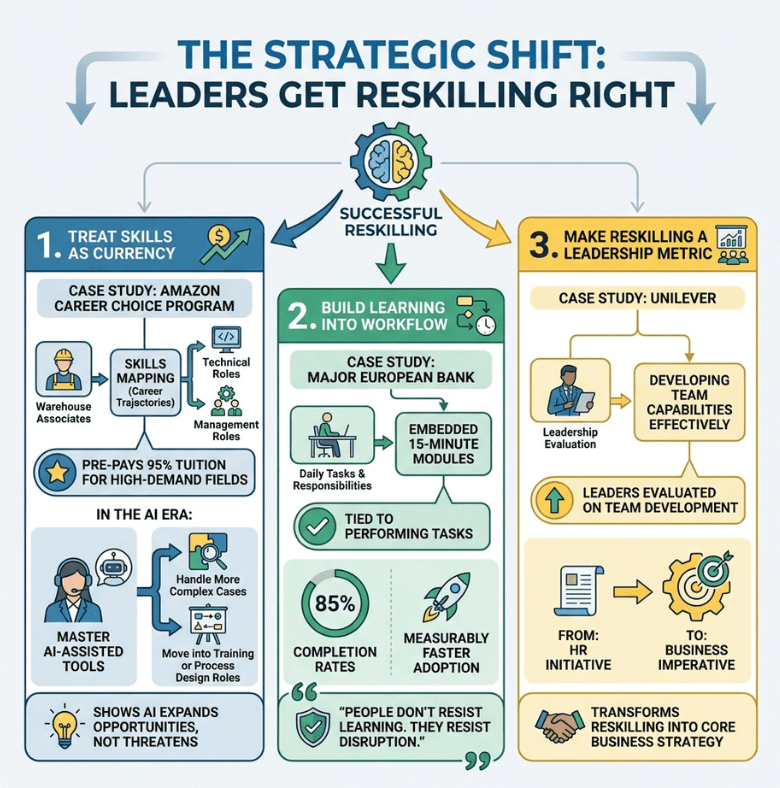
Leaders who get reskilling right make three fundamental changes:
First, they treat skills as currency. Amazon’s Career Choice program maps skills to career trajectories. Warehouse associates see exactly what capabilities will move them into technical roles or management. The company pre-pays 95% of tuition for high-demand fields.
In the AI era, this means showing people how working with AI expands opportunities rather than threatening them. A customer service rep who masters AI-assisted tools doesn’t become redundant—they handle more complex cases and potentially move into training or process design roles.
Second, they build learning into the workflow. When a major European bank needed to reskill thousands for digital banking, they embedded fifteen-minute modules into the workday, tied to tasks people were already performing. Result: 85% completion rates and measurably faster adoption.
People don’t resist learning. They resist disruption.
Third, they make reskilling a leadership metric. At Unilever, leaders are evaluated on how effectively they develop their teams’ capabilities. This single change transformed reskilling from an HR initiative into a business imperative.
Reskilling for the AI Future: What Actually Matters
A legal firm specializing in contract review wondered: Should we train paralegals in data science as AI tools emerge?
Their answer was more nuanced. They focused on three skill categories:
AI collaboration skills: How to craft effective prompts, validate AI outputs, identify errors, and know when to override automated recommendations. These are the new literacy skills.
Amplified human skills: Critical thinking, contextual judgment, ethical reasoning, relationship building—capabilities that matter more when AI handles routine analysis. A paralegal who spots business implications of contract clauses, not just their presence, becomes invaluable.
Adaptability skills: Learning how to learn, comfort with ambiguity, ability to integrate new tools rapidly. When AI capabilities evolve monthly, the meta-skill of adaptation trumps specific technical knowledge.
Within six months, their team handled three times the contract volume with the same headcount—and reported higher job satisfaction because they were doing more strategic, less tedious work.
The Hidden Multiplier
Reskilling doesn’t just prevent obsolescence. It unlocks innovation.
A Texas healthcare network struggled with patient scheduling inefficiencies. IT spent months with expensive consultants. Then they launched a program teaching clinical staff basic data analysis.
Within weeks, a nurse who’d worked in registration for 15 years identified a pattern in the scheduling algorithm that was creating bottlenecks. Her solution saved the network $2.3 million annually. She’d seen the problem for years but never had the tools to solve it.
When you give people new capabilities, they apply them to problems you didn’t know existed. With AI, this multiplier intensifies. When frontline employees understand how to leverage AI tools, they can prototype solutions and implement improvements at an unprecedented pace.
The Demographic Reality
A manufacturing CEO told me, “We used to compete for talent. Now we’re competing with demographic reality. If I can’t reskill the people I have, I’m not going to have people.”
AI adds another dimension. Organizations can’t hire their way to AI readiness—there aren’t enough AI-native professionals, and they command premium salaries. The only scalable solution is developing AI fluency across existing teams.
AT&T invested $1 billion in reskilling over five years, retraining half its workforce as its business shifted from landlines to digital services. The alternative? Layoffs that gut institutional knowledge, followed by expensive recruitment in an impossible labour market.
The investment wasn’t charity. It was survival.
Making It Real
Strategic reskilling starts with four questions:
What capabilities will we need in three years? Map the gap honestly, accounting for how AI will change your work.
Which roles will transform versus disappear? Most jobs won’t vanish—they’ll evolve. This distinction helps you reskill rather than replace.
Who has the potential to develop those capabilities? The answer is almost always more people than you think.
What would make it worth their time? Clear career paths, meaningful recognition, compensation increases, and seeing others successfully transition.
A regional bank created “pathways programs”—structured reskilling with transparent requirements and guaranteed role changes upon completion. Applications overwhelmed capacity. Retention improved. When they needed senior technical roles, they had internal candidates who understood the business deeply.
The Leadership Imperative
Nadella’s transformation wasn’t really about cloud computing or AI. It was about creating an organization where learning was the status quo, where skills evolution was expected, and where people believed their growth mattered to the company’s future.
The $8.5 trillion economic impact projected from reskilling represents millions of individuals who will either grow with their organizations or be left behind. With AI reshaping work at unprecedented speed, the window for action is narrowing.
Leaders who see reskilling as strategic don’t just protect their workforce—they unlock its potential. In the AI era, your competitive advantage isn’t the technology you buy. It’s how effectively your people can leverage it.
The question isn’t whether to invest in reskilling. It’s whether you can afford not to.
For more AI-related articles, continue reading: